Monday, 15 July 2013

Hoi An - Statistics, Suits, Ice-cream and Snorkelling

Over the past 4 months and 3 weeks I have slept in 82 different beds (thats an average of 4.5 a week). 10 of these beds have been on trains and 9 'beds' have been on buses*. I'm beginning to get slightly fed up, not helped recently by the fact that Vietnamese people are very rude compared to British standard. I know we have fairly high standards, but I am fed up of being pushed around, metaphorically and physically.

Whilst I have been scammed and ripped off in every country I've been to so far, in Vietnam it is so organised, and there are so many tourists its unavoidable. You pay the extra 100,000d because its a 'special bus' or you don't go, another tourist will pay the bribe and take the seat instead. On the pavements or in resturants, people try to physically move me, grabbing me by the shoulders, to get me out of the way. I have not yet tried this on other people to get them out of my way - I'm very English and give them a significant look instead. A bus driver will think nothing of pushing me and other passengers into our seats or slapping my feet so that I take off my shoes.

After the most recent two buses I've had enough. Thankfully those bues bring me to Hoi An, the perfect place to chill out for a bit, and spend 3 nights in the same bed. I decide that in Hoi An I am going to do whatever I want. If I don't feel like eating Vietnamese, I wont. If I want to spend the day on the beach instead of looking at temples then that's what I will do. I turns out that doing 'exactly what I want' involves eating a lot of pasta and home made ice cream (reading the book 'Eat Pray Love' at the moment may have something to do with this). I don't eat any Vietnamese food for 4 four days and I dont so much as glance at a temple.


The thing to do in Hoi An is to get tailor made clothes. There are 200 different tailors shops in Hoi An making mostly suits but also dresses, swimming costumes, jeans, shirts, anything. In preparation for all those job interviews im going to have when I get home, I get fitted for a trouser suit and a smart dress. I spend an hour choosing syle, fabric, linings and buttons, and over all have three fittings to make sure they're perfect. Its all done in just 2 days and the whole lot costs me $130.

I spend a day at the beach, renting a bicycle and risking the roads. Where as home it is the job of the person joining the main road to wait and look for a space, in Vietnam it is the job of the driver already on the main road to look out for people joining, who don't give even the slightest glance to the oncoming traffic. I spend a few hours on the beach swimming and sun-bathing (and getting slightly burnt, even though it is overcast), before heading back to town for a burger and more icecream.
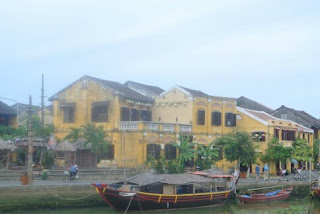


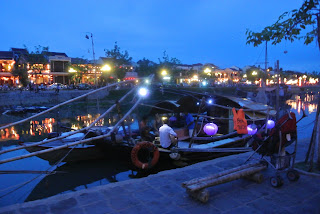
As five o'clock approaches I settle down outside a bar with a passion fruit mojito and was as the streets of Hoi An transform. In the evenings the old town is pedestrianised, fairy lights are turned on, lanterns are hung from trees and classical music is played from loud speakers. People promenade up and down the river, stopping in little resturants for drinks, dinner and ice cream. It probably sounds like a little town in France/Spain/Italy, and it looks like it too.



On my final day in Hoi An I go on a snorkelling trip with Charlotte, who arrived the evening before having spent a few nights in the town of Hue, which I skipped in order to have a few relaxing days. Most other people on our boat are trying scuba diving, but I'm glad I didn't fork out as we see just as much snorkelling. After pottering around two dive sites and some sun bathing on the boat we stop for a sea food lunch on one of the near by islands, and afer lunch we have an hour or so on the beach. The water is the clearest, cleanest water I have swam in so far, it is deep and refreshing and the perfect temperature, where as the water on Koh Tao beach is uncomfortably warm and mucky as a result.


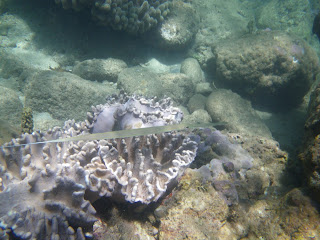


We get back to the main land just in time for me to pick up my rucksack and head to the bus station for my 12 hour bus to the town of Nha Trang, half way between Hoi An and Saigon. I don't, however, have time for a shower, which is fairly unpleasant, but I'm still cleaner than some of the backpackers I have seen recently.

* All together I have taken 15 trains and 33 buses (15 of 'tourist' and 18 public s. I have also taken 3 boats, 5 shared jeeps/mini buses and 3 planes. 

Thursday, 11 July 2013

Halong Bay

Something EVERYONE does when in Vietnam is a cruise around Halong bay, one of the 'New 7 Wonders of the World'. The Vietnamese claim that Halong Bay was created when a dragon rushed down from the mountains, carving its way through rocks before jumping into the sea, flooding the paths he had left behind and leaving only the tops of the limestone karsts visible.


Unfortunately the only way to see Halong Bay is through a tour booked in Hanoi, it can't be done independly unless one charters a whole boat. This and its popularity means cruises are touristy, the bay is crowded and it is almost impossible to find a reputable cruise company. Internet forums are packed witheih horror stories of leaking boats, food with cockroaches and stolen belongings. The trouble is that if you avoid the budget tours ($45) and splash out ($90), you often end up on the same  boat as everyone who paid the budget price. Charlotte and I paid ($60) for four meals, cave kayaking, squid fishing, a cooking demonstration, a tour of the 'Surprising Amazing Cave' and swimming at a beach.

Above: Artificially lit and paved floored 'Surprising Amazing Cave', named by the French because it has three chambers (the second surprises, the third amazes)

Above: Fisher woman from the local floating village

Above: Floating shop
We get to kayak, although not in a cave, and we are on a boat with a couple who had paid for 'luxury' (we paid for 'superior') so they're not happy. Our tour guide 'My name is Tong but you can call me by my nickname which is.... Jeremy' has excellent English but a hilarious accent. he is very rude, probably unintentionally, saying things like 'Get on the boat and get inside! Quickly!' as I struggle with my backpack. Overall the trip is alright, and I manage to get $5 back for the lack of cave kayaking. The scenery is without a doubt the best bit, and I would love to come back and actually charter my own boat.


Monday, 8 July 2013

Sapa. Trek & Village Stay. Part III

I wake up at around five in the morning, when the family and the rooster wake up, but go back to sleep until seven. Breakfast is spring rolls, rice, slices of pumpkin and coffee. Like the previous two meals I have been given it is delicious. The children eat noodles using chop sticks, and they do it better aged two than I ever will be able to.


After breakfast Mu dresses us up in their traditional clothing. First to go on is a long sleeved jacket, with embroidery around the collar and sleeves. It takes a year for a woman to weave the hemp, dye the finished fabric and stitch all the embroidery. Over the top of the jacket goes long sleeveless tunic, also embroidered. The jacket and the tunic are then wrapped around the body with a think belt which is, of course, also embroidered. H'mong women then wear practical black culottes which are made out of a velvety material and reach just above the knee. Around their calves they wrap more of the same material which is tied off with embroidered ribbons. As I said in my first post about Sapa, the whole thing looks amazing! Although more so on them than me.


Whilst we pack and the two year old Tsu plays with a knife, Mu washes her hair and I get a change to see how exactly H'mong women manage to style it they way they do. Whilst her hair is still wet she bends forward and gathers it together in a pony tail. She then puts three sliver clips in the pony tale, starting at the base with the others about half an inch apart. Then she wraps the pony tail around the back of her head, passing the base of her neck, back again to her forehead, where she secures the end with a silver comb. She does the whole thing in about ten seconds.


With Chan on her back again Mu leads the way back throught the rice paddy. Today's walking is only a few hours to a waterfall, then to the main road where we will catch motorbikes back to Sapa. Unlike yesterday the walk is all down hill. Like yesterday it is very slippery and we all slip at least once (except of course Mu ad Tsu). After an hour we leave the mud track and walk on concrete paths through the rice fields until we reach the river and a water fall. Tsu points out travellers in groups of 20 or more who have organised treks through an agency in Sapa. She says proudly, "We never take more than six people and you sleep in our homes whilst they sleep in dorms.


After a quick dip in the waterfall (there isn't much room for swimming) we walk up to the main road where Tsu organises motorbikes to take us to Sapa, a journey which takes only ten minutes and probably less if there went two people on the back. In town we say our goodbyes and say thank you over and over in both English and H'mong (O Chau!). We also write a review in Mu and Tsu's note book for them show other travellers and I am amazed to find out that, after getting a beer, they will be on the look out for more people to take trekking tomorrow.


A few days later I am taking to someone on a bus from Hanoi to Hoi An. Herhad stayed in a jungle village in Cambodia, and spent a long time telling me how, "Its a nice life, but only because they don't know what they're missing.. there's no way 'normal' people could do it" and I have to disagree, I think Mu and Tsu know what a great life they have. They bring in the money and walk where they want, bringing their children with them or not. They can go for a beer and can teach themselves to speak new languages to start their own business. They get married young but to young men who have lived in the same village as them their  whole lives. All of this which is much more than their mothers had, and much more than lots of the women I have met in the past four months. Yes, they don't know what else is out there. But I do and I still think they have a nice life, and I told them so.


Sunday, 7 July 2013

Sapa. Trek & Village Stay. Part II

The path through the rice paddy to Mu's house is narrow, muddy and rocky, but she negotiates it like someone who has been doing it several times a day for 10 years, which she has, whilst we slip and fall over and twist our ankles.She points to a red blob in a tree in the distance and says "That's my other son, Che, he likes climbing".


Below the tree is a pond filled with ducks and lillies, around which are a couple of houses and a pig pen filled with piglets. There is a vine covered arbour growing small pumpkins and a system of bamboo waterworks carrying water from the stream, past the house (with an off shute for washing and drinking water) and into the pond. The house is built in a lower case 'n' shape with the front door in the curve of the 'n', so outside there is a covered porch area overlooking the pond, rice paddies and the mountains across the valley.


I ask Mu if she thinks where she lives is beautiful and she replies "No, sometimes, when tourists tell me it is. I have only been here and to Sapa, and twice to Lao Cai, so I don't know". I assure her that it definitely is beautiful. She says we are lucky because the afternoon sun has burnt away the mist and we can see the mountains - as if it wouldn't be beautiful otherwise.


She unstraps Chan, sits him on the floor and introduces us to her other two children, a two year old girl also called Tsu, and Che, aged six, who begins to peel  hard green peaches (which taste bitter but nice)  with a very big and sharp knife. I can't watch. He later 'entertains' us by catching a dragon fly, pulling its wings off and throwing it in the air. I can't watch that either. Tsu is very shy and seems to like putting things on her head, her leggings, wellies, rocks, her wellies full of rocks and, at one point, a puppy, upside down.


Whilst Mu chops wood, washes clothes, washes children, cooks dinner and does some sewing we play with the children and eat peaches. We offer to help but she says "You are, you're looking after my children.".  She tells us that her children are always saying "Mummy, why don't you go to Sapa and bring back someone to play with us?". Her house is big, twice the size of Tsu's, but she wants to put in a second floor where tourists can stay.


In the evening her husband arrives on a motorbike with bottled water and, when Tsu returns with her husband we sit down for dinner. We have the same as what we had for lunch, as well as pork and spring rolls and boiled potatoes covered in butter and grilled pepper and pumpkin. The children eat their food on the floor whilst the ten of us; me, Charlotte, the Americans Adam and Caroline, Mu, Tsu, their sister in law (Mu's husband's brother's wife, the pregnant girl whose name I don't know) and their husbands squish around a low table below a single naked light bulb.


Halftime way through the meal the men produce a bottle of rice whiskey or "happy water". They teach us the word for 'cheers ' - 'Jun-Kha' - and for 'drink until you're finished - 'Hamazu'. This is said a lot and there is a lot of laughing at our inability to remember the words. They ask about our nose rings and tell us that they saw a girl in Sapa with a piercing through the middle of her nose. They said to her "Are you a water buffalo? Come with me and you can plough my rice paddy!".


Through out the evening we find out a lot about village life. Husbands normally look after the children while the women sell and go to the market, except when farming, when the whole family is in the fields. All children go to a Government funded school until the age of thirteen, where they mostly learn English. At home girls are taught to weave and sew. Mu tells me that if her daughter cannot sew then no one will marry her. Women over the age of twenty five- ish are considered too old to get married, although some will marry outsiders - Vietnamese, Westerners, other Asians - or marry into other tribes, such as the Red Dao. The h'mong are friendly with other tribes, they do not speak the same language but Mu tells me that they will say hello to each other at the market.


By the time we have finished eating and the bottle of rice whiskey is empty it is 23:00 The H'mong wake up at about 4:00 or 5:00 in the morning in order to make the most of the light and to walk to Sapa, so this is a late night. Tsu and her husband walk home and Mu's husband makes up beds for us on raised wooden platforms topped with  mattresses, pillows, blankets and a mosquito net. The family sleep on similar bedding on the kitchen side of the house. After all the walking, food and whiskey everyone falls asleep quickly and I'm only woken a few times in the night by the sounds of lowing water buffalo and crying children. 

Friday, 5 July 2013

Sapa. Trek & Village Stay. Part I

When we meet Mu and Tsu at the church in the morning it is raining. We are wearing our rain coats but they seem unphased, their hemp tunics don't even look damp. There are four other people on the trek, two girls from New Zealand and an American couple. As we start walking through the town and a few younger H'mong girls join us and an older woman, who turns out to be Mu and Tsu's mother. Our 'trek' is basically Mu and Tsu allowing us to walk home with them. They have already walked this four hour route this morning in order to meet us in Sapa.


Above: Chan eating watermelon

After a few stops in town to pick up some shopping, including a slice of water melon which Mu breaks  in to pieces and hands to Chang on her back, we turn off the main road onto a steep track. Because of the rain the rain the path is very muddy. Despite only wearing little plastic sandals and being either pregnant, an old woman or carrying a baby, the women help us up the slippery slope. They must find our walking boots and rain coats hilarious.


Above: A particualry steep and muddy section of the path


The rain soon eases off and every now and then we stop to look at small farms and villages, we see maize, green tea and marijuana which i'm told is grown mainly for the hemp in the stalk, which is used to make clothing. The stalks are dried in big bundles and then torn into strips which are weaved on a loom. We also see indigo plants which are used to dye the finished cloth. Mu shows me how women strip the hemp into strands whilst they are walking and wrap them into bundles around their hands.  She demonstrates on my hand, somehow managing to not look where she is walking, somthing I have to pay close attention to due to all the rocks and mud.  


Above: Tea


Above: Marijuana and drying hemp


Above: Soaking indigo for dye


Above: Weaving hemp

 At one point one of younger girls screams and points to the hedge where I see a small green snake. Mu shouts at me to move away and proceeds to hit it with a long stick of bamboo a then a rock before flinging it into the hedge. They tell me that it is very poisonous and lots of people die from being bitten when farming. One of the New Zealanders says 'Excellent, so woman with a baby on her back goes to kill it', but the other options are the small girls, the pregnant woman or the old woman. 


Above: Killing the snake


Above: Buying bread enroute


After a few hours we stop at Tsu's house for lunch. Women go to live in their husband's home when they are married so Mu, Tsu and their mother all live separately, although Mu lives with the young pregnant girl, who is her husband's brother's wife and just sixteen. This is her second pregnancy after a miscarriage last year.  The house has a hard dirt floor and wooden walls and roof with a small second floor forming a balcony or mezzanine. A dividing wall goes across half the room separating the kitchen from the living area. There are lots of small children everywhere, bare foot, filthy and making themselves even more filthy eating jelly without spoons.


Above: Tsu's kitchen

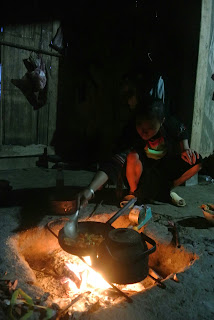
Low wooden tables and benches are produced and dish after dish of food is brought from the fire in a pit in the kitchen. We are all given a small bowl of rice to which we add tofu cooked with sweet tomatoes, cabbage, noodles, omelette and green chilly sauce. Having to eat stange food was one of my main concerns with doing a home stay, but I needn't of worried, it is all delicious. We are encouraged to eat as much as we want, but the H'mong all eat much more than us. I ask if they eat this everyday, and Tsu tells me that mostly they just have rice and vegetables. 


Above: Lunch


Over lunch Mu and Tsu tell us about their mother, the 'old woman', who it turns out is only 50. She has seven children. The oldest is 37 and the youngest is a boy of 10 - meaning he has nieces and nephews who are older than him. She doesn't speak English but wants to learn. I ask where Mu and Tsu learnt such good English. Two years ago, Tsu tells me, all she could say was "You buy from me". She decided to learn more by talking to tourists in the market. She progressed from phrases such as "Where you from?" "How long in Sapa?" and "My name is Tsu" to full conversations. She has more understanding of the language and better pronunciation than hotel owners in Hanoi, who mostly only understand basic questions such as "Do you have any rooms?". 


Above: Three generations

Mu and Tsu talk about how Sapa has changed in the past few years, what it is like selling to tourists - "Americans spend the most! I can sell them a $2 bracelet for $15 and they won't even try and haggle!" and how many guests they get a week - sometimes three or four groups, sometimes none. 

After lunch everyone, including the extra children , walk for 10 minutes down the track to the turning to Mu's house. Here Tsu takes the couple from New Zealand to the main road to catch a motobike back to Sapa. The Americans, Charlotte and I follow Mu and the children climb a wall and walk through the rice fields to Mu's house where we will be staying the night. 


Above: Dry stone walling  - just like Dartmoor!


Tuesday, 2 July 2013

Sapa

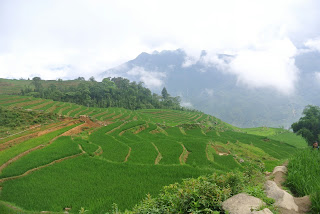
Having spent a few days in Hanoi I head north to the mountain town of Sapa. A lot like Darjeeling and Dharamsala in India, Sapa is ugly town in beautiful surroundings and filled with tribes people who have walked from their villages to sell their handicrafts.


Above: The Road to Sapa
Above:Sapa
There are five tribes around Sapa, the Red Dao and the White, Green, Black, and Flower H'mong. The largest group is the black H'mong, at around 900 in the immediate area. The Black H'mong walk around Sapa in their magnificent traditional costumes made of indigo dyed hemp. On top they wear dark blue (almost black) tunics which reach below the waist and are secured with a thick, embroidered belt around the stomach. They then wear balck cullots to the knees, and black leg warmers tied with more embroidery around their calves. On their heads they either wear conical hats (again black) or fill their long hair with silver clips and combs. 


They wear all the jewelery which they are trying to sell, meaning their arms, necks and wrists are all choked with silver. Their ears are long from their heavy earings and many of them have gold teeth. I think the whole thing looks amazing; practical, comfortable and most of all strong - particuarly due to the babies as old as two strapped to their backs all day, which they have carried for hours from their village, along with everything they are going to sell while H'mong men ride around on motorbikes. 

Above: Black H'mong Selling Cushion Covers


They have excellent English and approach tourists in the market, asking the usual questions (Where are you from? What's your name? Is this your first time in Sapa?) then they get to the point - "What are you doing while in Sapa? Trekking?". There are plenty of trekking agencies in Sapa, but my guide book and other tourists have warned me against using them as they are expensive, touristy and don't employ local people such as the H'mong. 

Instead the best way to arrange a trek and home stay is to wait until you are approached in the street and a home stay is offered. Within half an hour of arriving in the town I am approached by two women, one with a sleeping baby strapped to her back. They are sisters called Mu (24) and Tsu (22). Mu has three children aged 6, 3 and 9 months (the very happy baby on her back - Chan) and Tsu has two children aged 4 and 18 months. They ask me where I'm from, how old I am and if I'm married. They say,
 "You're 23 and not married!? If you were a Black H'mong you would have been married for 8 years already and have three children!". 
They ask if I would like to come and stay in their village, and I say that I would, but I have to talk to my friend Charlotte, who is arriving tomorrow.  


Above: Mu and Chang
By the time I catch up with Charlotte she tells me that she has also been taking to a Black H'mong woman offering a home stay and, since the day before, I have spoke to two more women. We are struggling to choose one when Mu ans Tsu walk past, and are thrilled when I recognise them and remember their names. They must speak to tens of tourists a day, none of whom recognise them as they all look fairly similar in their tribal wear.  They ask again about the visiting their village and I say,
"But everyone invites us, we can't choose!"
"So just come with us!", they say.
I can't fault their logic so we 'book' two days of trekking and an over night stay in their home. Booking involves agreeing a price ($35) and a pinky promise to meet tomorrow at the church at 9:30.