Saturday, 15 June 2013

Beautiful Luang Prabang, Laos


Above: Luang Prabang Tuk Tuk


Above: The Night Bazaar - Set up on the main road at 17:00 every 
evening, all down again by 22:3


Above: The Food Market. 10, 000 kip (c.75p) fill a plate buffet.


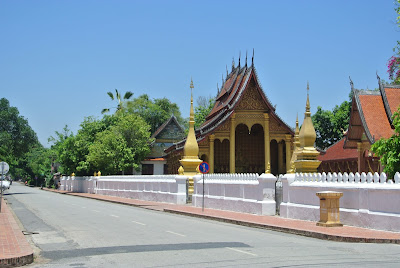
Above: Clean streets (a novelty) and a temple (definitely not a novelty)


Above: Amazing second hand book store showing films in the evening and stuffed with National Geographic magazines. 


Above: Streetfood. Batter cooked in what looks like an electic egg 
poacher and served in bamboo leaf baskets


Above 3: 'Indo-Chinese' style buildings 


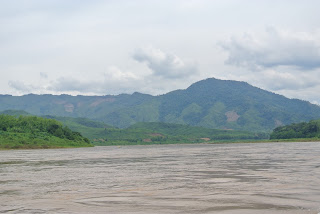
Above: The Mekong


Above: Me on the rope swing at Kuang Si Falls


Wednesday, 12 June 2013

Thailand to Laos - Days 3&4/4

The last two days of my journey into Laos are via a 'slow boat' down the Mekong river to the city of Luang Prabang. A slow boat is a cross between a Thai longtailed boat and a canal boat. The sides are open and the seats look like they have been ripped out of a minibus.


I get up at 7:30 to buy my slow boat ticket and to get a good seat - apparently the engine is deafeningly loud so it is best to sit as far away from it as possible. At the ticket office I am told that the boat won't leave until 11:00 (the day before the man said ' Come at 8:00, 9:00, maybe 10:00') and I have the first ticket, but by 8:30 there are people saving their seats.


By the time we leave there are about 70 people on the boat, most of them western travellers. A small girl of about 8 years old seems to do most of the work - collecting tickets,  handing out plastic bags for people to keep their shoes in and running the small shop which sells beer, coke, pot noodles and crisps.

The scenery along the river is very very green, a nice contrast to the muddy brown river, the banks of which are lined with sandy beaches and limestone rocks. We occasionally stop at small villages to pick up or drop of packages and every now and then I see fishermen and children swimming in the river.


After 6 hours we stop at the town of Pakbeng. Like Huay Xai people never stay here for more than one night, and we are faced with the usal hoard of touts advertising their guest house before anyone has even stepped off the boat - 'Do you have a room for the night? Wifi, very clean, only 80, 000 kip'. I split the price of a room with Kelsie, a Canadian girl I met the day before, and we are taken the short distance to the hotel in the back of a truck - it would probably take less than five minutes to drive the length of the town and back again.


That evening it rains. A lot. The boat leaves at 9:00 so at 8:00 we walk down to the pier and buy sandwhiches on the way. By the time we get there the front half of the boat is full of the people who were stuck in the back by the engine yesterday.

The journey is much the same as the day before, except it is raining, colder and the river is very full. The scenery doesn't change much but there is still a lot to see. At one point we pass a temple built into the cliff face, which my guide book tells me is full of unwanted budha statues and just a couple of hours outside of Luang Prabang.


After just seven hours altogether (two hours fewer than I had been told) we stop at what looks like another village but turns out to be Luang Prabang. The pier is just a grass bank and we cross a gang-plank to get off the boat whilst our bags are tossed over the water and onto the mud. A twenty minute tuk-tuk ride takes me to the city centre, where I find a guest house and head to the night market. Here I can fill a plate with food from a buffet - noodles, potatos, curry, rice, spring rolls, fried vegetables - as high as I can all for 10, 000 kip (75p). The food is then heated up and has seasoning added to it. There are little wooden tables and chairs dotted around with candles and jars of chopsticks. I think I am going to like Luang Prabang.


Tuesday, 11 June 2013

Thailand to Laos - Days 1&2/4

Although I'm 'travelling', a lot of the time getting from A - B seems like a chore, something that has to be done rather than an experience to enjoy. There have been lots of journeys when this wasn't the case; riding on the roof of the bus in Nepal, going from jungle to desert on a train in India, or the ferry to Koh Tao. But, however spoilt it sounds, a 17 hour bus journey can get boring even when it's through an exotic new county.

My journey from Thailand to Luang Prabang in Laos was one of the journeys that I definitely appreciated in itself, not just as a means to an end. It took four days, two buses, three boats, two rickshaws and one ride in the back of a truck.

Day 1.From Chiang Mai I catch a 'tourist' bus to  Chiang Rai, a town in the very North of Thailand and close to the Laos boarder. It takes five hours so I stay the night in what was probably the best hostel I have stayed in so far. A cold drink on arrival, wifi, pillows, sheets, towels, aircon, power showers and a common room with Sky TV. All for 200Bhat (£4) night. And breakfast is included.

Chiang Rai is a small town and after exploring the night bazaar, which sells mostly tshirts and meat on sticks, I indulge in some television and a snickers bar, feeling very un-traveller-y.

Day 2.After a BIG breakfast of as much toast and as many bananas as I can eat I schlep my bag to the local bus station and board the public bus the boarder town of Chiang Khong (Chiang means 'city' in Thai). The journey takes three hours and costs only 65bhat (£1.50). Travel websites had warned me that this trip was tough - hot and uncomfortable but authentic. So I was expecting three people to a seat,  chickens on laps, sweltering heat and loud music - I was expecting India. However there were only six other people on the bus, the huge windows meant there was no need or air conditioning anyway and I couldn't see any animals on the vehicle - although I'm sure they were there. Through my open window I saw farms and villages and lots of rice fields. Rural Thailand seems very far away from Bangkok and Koh Tao.


The moment I step off the bus in Chiang Khong I am asked by a rickshaw driver 'Laos?' and before I can answer my bag is thrown into the back of the 'rickshaw', which is more like a large lawnmower with seats. I have just enough time to climb in the back before he starts driving off. Climbing onto stranger's law mower, with out knowing where they're going isn't actually as unsafe as it sounds. In most places I have been, the locals seem to know where a traveller wants to go (in this instance, every white person in Chiang Khong wants to go to the pier). In India, I could turn up at a bus stop and just wait until someone said 'Golden Temple? this bus' and I would get on, and stay on until someone said 'quick, your stop!'. I was never once missed my stop, even when I didn't know where my stop was, and not once did I end up where I didn't want to be.

I get my Thai visa stamped at passport control, a hut from which I can see Laos on the other side of the muddy Mekong river. From an even smaller hut on the boat ramp I buy my 40b ticket (which seems expensive as my three hour bus was only 65b) and walk five steps to the long tailed boat, where my ticket is taken of me by the same man who sold it to me and who is also the boat driver. After much pushing and shoving to get the end of boat off the ramp and into the water, the 11 other people, a mixture of Westerners and Asians, and I are whisked across the river and in two minutes were in Laos.


Above: Chiang Khong Pier (Thailand)


Above : Arriving in Huay Xai (Laos)

On the other side I pay $30 and get my Laos visa, a process which involves filling out two almost identical forms and takes only 10 minutes. The boarder town of Huay Xai (don't ask me how it's pronounced) has one street and twenty guest houses - according to the owner of mine no one stays more than one night. So far Laos is not so different from Thailand. Huay Xai and Chiang Khong are practically one twon with a river running through the middle, although I notice one difference on the menu of the restaurant in which I, and everyone other traveller in town, have dinner.


Above: The difference between Laos and Thailand. 
NB Pad Laos tastes the same as pad Thai - its all fried noodles


Above: Trucks being transported up the river 


Above: Sunset over the Mekong 

Saturday, 8 June 2013

'Wat Phra That Doi Suthep' (A Temple in Chiang Mai)

Because I didn't climb enough steps during my Annapurna trek, I visit 'Wat Phra That Doi Suthep', a temple, located in the moutians just outside Of Chiang Mai. Thankfully there are only 309 steps leading up to it and I get driven up the mountain in one of the uncomfortable 'sorngtaaou' (a roofed pick up truck with benches in the back - I think they look a bit like 1950s fire engines) used instead of buses around the city.


Above: A Sorngtaaou


Above: Inside a sorngtaaou - the bad driving, sideways benches 
and lack of doors create a very real risk of sliding out the back


Above: Steps up to the temple

The temple was 'chosen' by a sacred relic of the Buddha which was mounted on the back of a white elephant who was then left to wander. Where the elephant eventaully stopped and died, known as Doi Suthep, the temple was built. The temple complex is filled with pagodas, shrines, bells and Buddhists, who are having their pictures taken whilst sitting in the 'mermaid' position (legs tucked behind them) in front of the main chedi - the copper plated tower.


Donation boxes are by far the most numerous feature of the temple. There are rows and rows of them which look like letter boxes and enable the giver to choose where their donation will go (monks, building temples, students or 'oldsters'). There are also donation bowls in front of every shrine and coins stuck with wax to statues.


Above: Donations


Behind the main temple there is a view of the whole of Chiang Mai, showing just how square the old city is. Built in 1296 the 1.5km square town is lined with a moat and, originally, walls which are now mostly collapsed. Before leaving I buy a huge, yellow corn on the cob from one of the many street food vendors and, as I've often done when eating fresh fruit and vegetables recently, note (and lament) how more flavour it has compared to what we get at home.


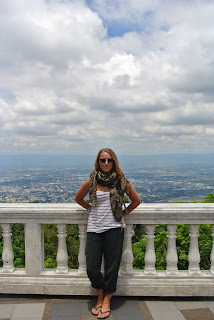
Above: View of Chiang Mai


Above: Canal around old Chiang Mai


Wednesday, 5 June 2013

Chiang Mai - Thai Cooking Course

After a week of diving and a week of doing not very much on the beach I have finally left Koh Tao. Two night buses take me north to the city of Chiang Mai, with a day in Bangkok in between. Alex is staying on Koh Tao for the next two months and Charlotte has gone to the island of Koh Phangan with Gemma, a friend from university. I am really looking forward to travelling alone for a bit - I also get two seats to myself on both buses, meaning I actually get some sleep. 


Above: Leaving Koh Tao

As soon as I walk into my guest house in Chiang Mai - recommended to me by friends for its excellent tours and onward travel organising - I am asked if I want to go on the Thai cooking class starting in an hour. Having planned to do this anyway I see no point in putting it off, so I find my room, shower, send some very beachy clothes to be washed and head downstairs.There are 11 other people on the course and we are all driven in the back of a jeep to the local market where we learn about the different ingredients we will use while cooking. 


Ingredients include mushrooms, lime, ginseng, lemon grass, chilli, pineapple, peanuts, ginger, fresh tumeric, coconut milk, basil (sweet, lemon and hot), oyster sauce, chives, spring onion, chicken, tofu, palm sugar and soy. These are just the 'main' ingredients.

Next we are taken to a large garden outside the city where, under a bamboo canopy, there is a makeshift kitchen with little gas ovens and huge knives laid out alongside chopping boards. We get to choose which dishes we make from a long list, but everyone choses pretty much the same - spring rolls, green or red curry, banana in coconut milk, sweet and sour soup and chicken with cashew nut stir-fry.


Next we are taken to a large garden outside the city where, under a bamboo canopy, there is a makeshift kitchen with little gas ovens and huge knives laid out alongside chopping boards. We get to choose which dishes we make from a long list, but everyone choses pretty much the same - spring rolls, green or red curry, banana in coconut milk, sweet and sour soup and chicken with cashew nut stirfry.


Above: The Kitchen


Above: Sugar, Oil, Oyster Sauce, Vinegar


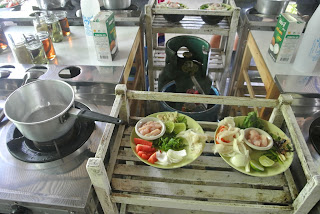
Above: Ingredients for Pad Thai

Our teacher, Joe, is very funny and likes to shout 'STIR STIR' at us and regularly checks to make sure we have the correct number of fingers. When we are making curry paste, Joe tells us that Thai men look for a good, hard working wife by seeing how lazy she is when using a pestle and mortar. He tells me that I will be a bad wife, which is fine with me - especially as I have already gotten large amounts of chilli in my eye even without pounding it sufficiently. 


Above: Making Red Curry Paste


Above: Red Curry

When we finish the course we get a certificate and a book of the recipes we have used. I take a very large bag of food back to the hostel with me, and I'm amazed that some people managed to eat all six courses. I'm hoping that the lesson will pay for itself in that I won't have to buy meals until I get to Laos.


Above: Spring Rolls - Delicious!