Thursday, 25 April 2013

Varanasi


Wow. Varanasi is amazing, definitely my favorite place so far. Having spent three weeks in chilled out Nepal I was feeling apprehensive about heading back to India, and the journey to get there wasn't helping - two buses, two auto rickshaws, one cycle rickshaw and a SIX HOUR delay on the train. However the moment I unwedge myself and my bag from the final rickshaw and plunge into the labyrinth of alleys in old town Varanasi I forget about the past 24 hours. It feels like 'real' India. There are cows everywhere - but mostly standing in the middle of the alley, eatting rubbish and refusing to move. So I have to squeeze past and try to avoid getting whipped with their tail or worse - their horns. There is street food made out of things I can't even recognise and a chai seller on every corner (and there are a lot of corners). The alleys twist and turn for miles - I'm sure a person could get lost in them for days, let alone the hours I probably accumalte walking in circles (and squares and triangles and other unknown shapes), despite my attempts to keep orientated. I keep saying stupid things like 'Oh, I know where we are, I recognise that cow!'.


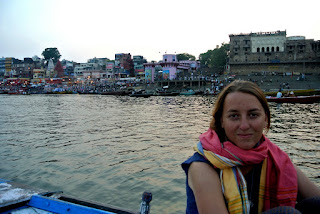
Not once in the four days that I am there do I manage to find my way back to my hostel without taking a wrong turn and needing to ask for directions. I'm fairly sure that the streets shift just before I turn a corner, as I feel like I never walk down the same alley twice. The guide book advises 'if you get lost, head for the ghats'. This is easier said than done, what with being lost, but there is always someone to ask and even more people to tell you whether you ask or not. Eventually the alley spits me out into the bright sunshine onto rows and rows of steps, or ghats, leadings down to the filthy Ganges river.


 Varanasi is the holiest of the seven Hindu holy cities and one of the oldest living cities in the world, the site having been inhabited since the sixth century BC. Life in the city revolves around the ghats, of which there are a hundred. Each ghat has its own religious significance, and some some are more popular than others.


The most famous is the Manikarnika, or Burning Ghat, where bodies are publically cremated. My guide book says that 'Seeing bodies being cremated so publically has always exerted a great fascination for visitors', and I am no different. I learn so much about this ghat and its traditions that I will write a separate post about it.

Much of my time in Varanasi is spent walking up and down the ghats observing day to day life. The water of the Ganges is considered to an 'elixir of life' and bathing in it washes away the bather's sins. As such there is a continual stream of people pouring out of the alleys, down the steps and into the river to wash. This doesn't make much sense to me as, despite the river's historical religious significance, it is now filthy. More than filthy. There are dead animals, live animals, litter, unidentified scum and, apparentlty, the waste from a chemical plant up river all in the water. Whislt washing in it may metaphorically clean you of sin, physically it would make you dirtier (and less healthy) than before you went in.


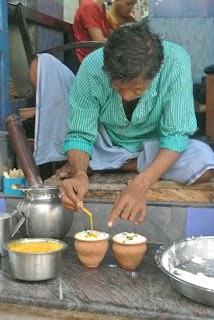
For all the time I spend lost and wondering up and down the ghats, I spend about as much in 'Blue Lassi', a tiny hole-in-the-wall lassi shop which is famous in Varanasi. A 'lassi' is a yoghurt drink, usually served pain, salted or sweet. Blue lassi serve theirs wih fruit, and claim to have 'any fruit you want madam'. In reality there is mango, apple, pear, grape, pomegranate, banana, orange and papaya. Any combination of these can be requested, along with chocolate and coffee.


The lassis mixed up right on the side of the street and served in deep terracotta bowls. A man runs back and forth with fruits, ice and big trays of set yoghurt curd. The old man mixing the lassis seems very used to having his picture taken, and also works very quickly. When I ask, the 'runner' tells me that they go through about twenty to twenty-five dishes of yoghurt curd a day, each one making about twenty lassis. During my four days in Varanasi I have about seven lassis, several of them free as the owner recognises us after our second visit. As well as lassis we are given chai from the owner's mother's chai stall next door and handfuls of fruit everytime the runner goes past.

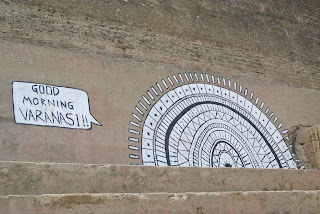
A couple of lassis a day along with a few street snacks are enough to keep me full all day, making Varanasi very cheap, particularly with our 300 rupee, river view room. I am very sorry to leave lively Varanasi (there was so much more than what I have meagerly tried to describe here) for distant, dusty Amritsar, and hope we can come back in a few weeks time with our friend Charlotte, who arrives in Delhi on the first of May.


Sunday, 21 April 2013

Chitwan National Park

After our trek we spend a couple of days relaxing in Pokhara, including a very good but slightly painful massage. I feel more bruised the day after than I did from the trek in the first place. We then head to Chitwan National Park for a few more days in chilled out Nepal before heading back to hectic India. Our hotel, in the town of Sauraha, has a garden which runs down to the river which borders the park. After booking a mammoth tour for the next day, we spend most of the first evening sitting in hammocks with sundowners and watching the wildlife.


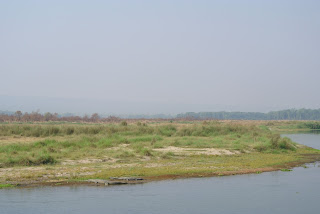
At 7:00 on our first full day in the park we head down to the river for a canoe trip. The canoe is a wooden dug out and we are sitting below the level of the very shallow water - almost on the river bed if the sound of the scraping rocks is anything to go by. Our guide points out sun-bathing crocodiles (a lot smaller than I had expected) and lots of birds including bright blue kingfishers (much larger than I had expected). After an hour of floating down stream we get off the boat in order to walk a little way through the jungle to the Elephant Breeding Centre.


Above: (very small) crocodiles 

The center has 25 elephants, including (at the moment) a one month old baby and four year old twins. The centre was established in 1989 when taking elephants out of the wild for training became too expensive and unsustainable. To prevent inbreeding, the females are released into the wild to mate with wild male elephants. Elephants are taught numerous commands such as sit, stand, line up, pick up with your trunk, carry with your tusks, pass to the Mahout (driver) as well as their left and right. Each elephant has the same mahout from birth and they are used for elephant safaris and forest work.


 We head back back to our hotel which is located on the strech of the river where the elephants are washed. It is free to watch the elephant bath, but you need to tip mahout 100rs to join in. Joining in includes sitting on ths elephant's back whilst he gives you a shower. To get on, the elephant helpfully lies in the river, but there is still a very big step up. The mahout stands behind us on the elephants's back and shouts a lot as the elephant sprays us (me right in the face) with water from his trunk. The mahout asks if we want the elephant to swim, but I'm not quite sure what he means as the water is far too shallow. It apparently means that the elephant lies down whilst I wonder whether I'm supposed to try and hold on or jump of. I end up half falling, half jumping in the river and trying not to land underneath the elephant. After the long hot jungle walk to the breeding centre I'm feeling a bit sick but, despite (or maybe because of) the massive jet of water out of an elephant's nose and in my face, the water cools me down and I feel much better. Having had our shower we then wash the elephant whilst he lies in the river, his trunk just poking out of the water. This is much more relaxing, for the elephant as well as me, and he seems to enjoy it as much as I do.


In the evening we go back to the breeding centre for an elephant safari. There are five of us on our elephant, including the 'driver'. We sit on a wooden platform (one to each corner) which is tied to the elephant under its tail and around what I suppose would be its chest. The driver sits on the elephant's neck with his feet in stirrups tied to his ears - the elephant's ears, not the driver's. I worry that five will be too heavy, but I see whole familys of seven or eight on some elephants. We set of in a line of about four others, it is very wobbly, especially when the driver urges the elephant into the next gear, which I think is suposssed to be faster, but it isn't really, just more bumpy.
The benefit of an elephant safari is that the elephant masks the scent of humans, meaning it is more likley that you will see other animals, but the families on the other elephants are very noisey, and one child is crying, so I don't expect to see much. However, we soon see peacocks, large sambar deer, spotted deer, monkeys and - best and most surprising of all, one horned rhinos. The five elephants and thirty or so people crowd round and the rhino doesn't bat an eyelid (maybe rhinos don't have eyelids). We later see two more rhinos, one looks at us and walks off, the other stamps his feet a bit, makes a snorting noise and again, walks off. After dinner by the river I go to bed early, trying not to scratch my mosquito bites, in preperation for the seven hour journey to India the next day - next stop, Varanasi!


Saturday, 20 April 2013

Trek Days 7 & 8

Day 7. Sinuwa to Banthanti

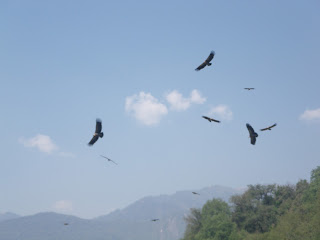
Day seven is HARD. We get up at 5:30, climb down from Sinuwa to the river, up to above Chomrong then down again to another river. Up to Tadapani, down and then up to Banthanti. Some where between the first up and the second down we turn a corner a see the sky filled with vultures. We walk further along the trail to find that they are landing to eat the carcas of something - maybe a goat or small cow,we can't see and don't want to get too close - which we think has been put there deliberately as it is on a rocky platform just up the hill from the path. As the vultures come into land they fly right over our heads, and we can hear the great big woosh of their wings. We can also hear the ripping and cracking of the carcas as it is pulled apart. Although we can see their underbellies very clearly, the photos don't do justice to just how big and close they are. We stay for half an hour trying to get good shots but they take off and land very quickly. We move on when our necks get sore from looking up and when our faces start getting burnt from looking into the sun.


After a long hard day we arive in the tiny town of Banthanti. It consits of three tea houses all spaced abour 15 minutes walk from each other in a narrow wooded valley. We stay in the third which we get to at 16:00. We have been walking for nine hours but are too cheap to pay the 100 rupees for a hot bucket shower. Instead I go and wash in the icy river and Alex follows reluctantly. The tea house is called 'NiceView Lodge' and is one of many 'Nice View' lodges we have passed, along with 'Good View', 'Green View', 'Excellent View', 'Excellent Green View', 'Mountain View'.... you get the idea. We look for, but are disappointed not to find, something along the lines of an 'Average View Lodge'.


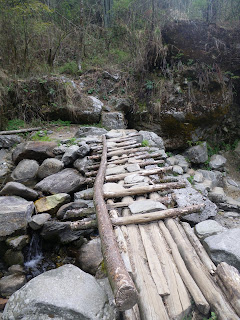
Above: Steps down from Sinuaw


Above: Traditional Nepali bench, built to be just the right
hight for a porter to put their basket down on. 

 Day 8. Banthanti to Pokhara!

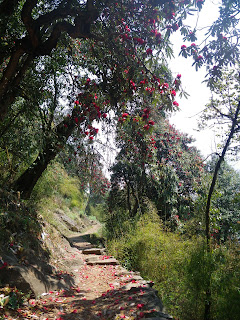
Our lodge owners tell us that, if we stop at the Poon Hill view point, it will take two days to get down to Nayapul (where we can get a bus to Pokhara). We are tired and dirty and determined to do it in one. After a breakfast of fried eggs and Tibetan 'Gurung' bread - a sort of round, sweet naan but slightly less heavy - we head up the valley. It is six in the morning and very cold but some of the best scenery I have seen so far. The forest is dense and we climb gradually upwards along the stream seeing monkeys, water voles and lots of kingfishery type birds. The rhododendrons are even more spectcular than on the ABC trail, which were a couple of weeks past their best. We don't see anyone else for two hours, when we get to the top of the hill and meet other trekkers coming from the town of Ghorepani, who are probably on their second day. They all look vey clean and eager.


When we get to the view point it is 9:30 and already too foggy to see the mountains. I'm not too bothered, having had amazing views all week. Now I just want to get to the bottom. From Ghorepani it takes us six hours, all down hill (which is harder than it sounds), to get to Nayapul. An hour away from Nayapul my knees give in from all the steps and I actually need my walking pole just to keep myself upright. We turn corner after corner, hoping that we are nearly there, and pass fresh trekkers who say that they have only been walking for an hour or so. Groups of children run up to us and hold out their hands saying 'chocolate' and I hold out my hands saying 'yes please'. They don't get it. Eventually we hobble onto the main road and wait for a taxi back to Pokhara, When none turn up for 20 minutes we get on the public bus. Literally. When it pulls up the conductor says 'full up - up top!' and points to the roof. So up we climb, the last climb of our trek. Despite the uncomfortable rungs we have to sit on, the cold wind and then eventual rain drops, the journey makes the last few agonising hours of our trek worth while, we definitley finish on a high.


Above: On top of the bus


Above: Children dressing up a goat I
 in a wooly hat


Above: A very sure of itself sign (at this point it happened to be right though)

Monday, 15 April 2013

Trekking Days 4, 5 & 6

Day 4 Chomrong to Himalaya

Today we start on the path directly to base camp, meaning the trail will get very congested as everyone will be going to the same place. We leave at 6, planning to beat the crowds, but take a wrong turn heading for half an hour up the wrong hill. When we get back on track, we are stuck in the middle of the morning rush hour. We over take a group of about thirty Koreans, then jog all the way down the valley to over take a group of 20 French trekkers. When we get to the bridge below we rest of two minutes only to see them slowly but surely coming around the corner. So reluctantly we get up and march up the hill on the other side to the town of Sinuwa. I am exhausted and boiling hot when I get there and dismayed when, once again, it takes only a few minutes for the French to catch up and over take us. Slow and steady with two walking poles and a porter seems to be the trick to this trek.


Above: Chomrong to Sinuwa

View of ABC from Sinuwa

The path goes upwards but gradually - no more endless flights of steps - though dense oak and bamboo forest crowned with rhododendrons probably only a week past their best. We had planned to make it to the town of Bamboo today, but end up going two towns onwards to 'Himalaya' at 2920 meters. This means that we can get to base camp a day early and I am excited at the prospect of seeing snow and needing to wear my down jacket. It is vey cold that night. Everyone huddles together for dinner in the draughty dinning room for dinner instead of sitting out on the terrace. I sleep with my sleeping bag wrapped tight around my head.


 Day 5. Himalaya to Annapurna Base Camp (ABC)

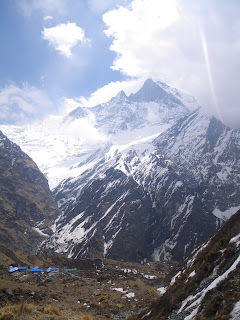
Walking up to base camp is tough. The path is much rougher than previous days, with rocks and roots all across it, meaning it is impossible to get a good rhythm going when walking. It also means that I trip a lot because, instead of paying attention to the path, I am constantly looking up at the mountains on either side (snowy on the right and rocky on the left). There are lots of porters, incluing tiny women, carrying huge baskets, supported by a strap around their foreheads. Most of them are wearing jeans and flip flops and playing music from their phones. They all over take us. We pass through two towns, each about 40 minutes apart, before getting to Machupuchare Base Camp at 3700 meters. We stop here for an hour to aclimate and prevent altitude sickness.


Valley leading to MBC & ABC

Female Porter


Machhupuchhre Base Camp

There are helicopters flying up and down the valley constantly and landing to drop off people and equiptmemt. One person tells us there is a photo shoot going on for the Korean outdoor clothing company 'Black Yak', another tells us that a Korean documentary is being filmed about some climbers who died trying to summit Annapurna 1. Apparently there is a 50% mortality rate for summiting Annapurna 1, and it is a much more technical climb than Everest. Machhapuchhre on the other hand, has technically never been summited. Because of its flutted peak and Fishtail shape, the mountain is holy to Hindus. It is disrespectful to bring meat near the moutain and permits are not issued for climbing it, although one group got within 50 meters before stopping.


View from Machhupuchhre

Path to ABC just before it began to snow

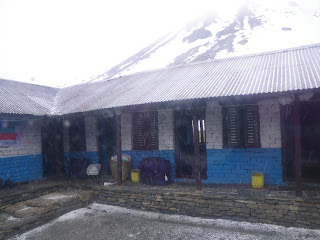
As we make our way up to Annapurna Base Camp (4130m) it begins to snow. An hour later we walk under the 'Annapurna Base Camp' welcome sign and find a dorm in one of the three tea houses. It is about 14:00 and we spend the afternoon huddled together with other trekkers in the dining room. I am wearing all my clothes and there is a heater under the table but I'm still frezzing. There is no view as the snow storm is too thick.

I order a 'dal bhat', a traditional Nepali dish of rice, lentils and vegetables. It is the most expensive meal on the menu at 650 rupees, but the price includes free refils. Nepalis eat this meal twice a day and fequently quote the expression '24 hour, dal bhat gives you power'. After three helpings it certainly fills me up and warms me up to some degree. Everyone runs through the snow from the dining room to their rooms at about 18:30 for bed. I sleep in all my clothes - leggings, trousers, t-shirt, thermal top, waterproof, down jacket and two pairs of socks - and tie my sleeping bag around my head, but I'm still not as warm as I would like. My alarm is set for 5:00 in order to be up to see the sun rise over the mountains.


 Day 6. ABC to Sinuwa

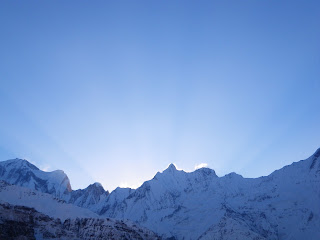
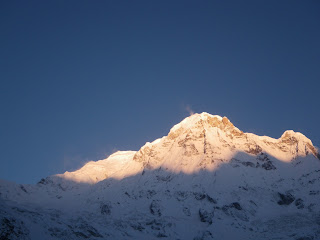
When I wake up it is still very cold, but when I brave the outside I see that the storm the night before had been worth it. Where as when we arrived everything had been grey and dirty, now everything was covered in about a foot of snow. Slowly people emerge from their rooms and congregate a little way away from the tea houses to capture the sun rise. It gets even busier as more and more people arrive having made an early start from Machhupuchhure base camp and everyone is trying to get photos without other people in.


The walk down takes longer than we had hoped, as the path is slippery with compacted snow. Walking off the path is tricky as there are rocks on either side and its hard to tell where a big hole might be. Apparently the walking time between Chomrong and ABC is only twelve hours going up, about ten going down. The guide book advises spreading the walk over three or four days to avoid altitude sickness. We go up in two (I only get a mild headache and pins and needles in my fingers), but we would like to get back to Chomrong in a day as we are running out of money (no ATMs!) and it is cheaper further down the mountain - meaning we can spend more time trekking. We don't get to Chomrong because of the slippery walk down, but we get to Sinuwa, one town across the valley and 1770m below ABC at 2630m. It is nice to be warm again, although there is no hot water, meaning I have been wearing the same clothes without showering properly for three days. Yuck.